
Crypto Payouts at Sweepstakes Casinos: Bitcoin & Ethereum Guide
 Available in US
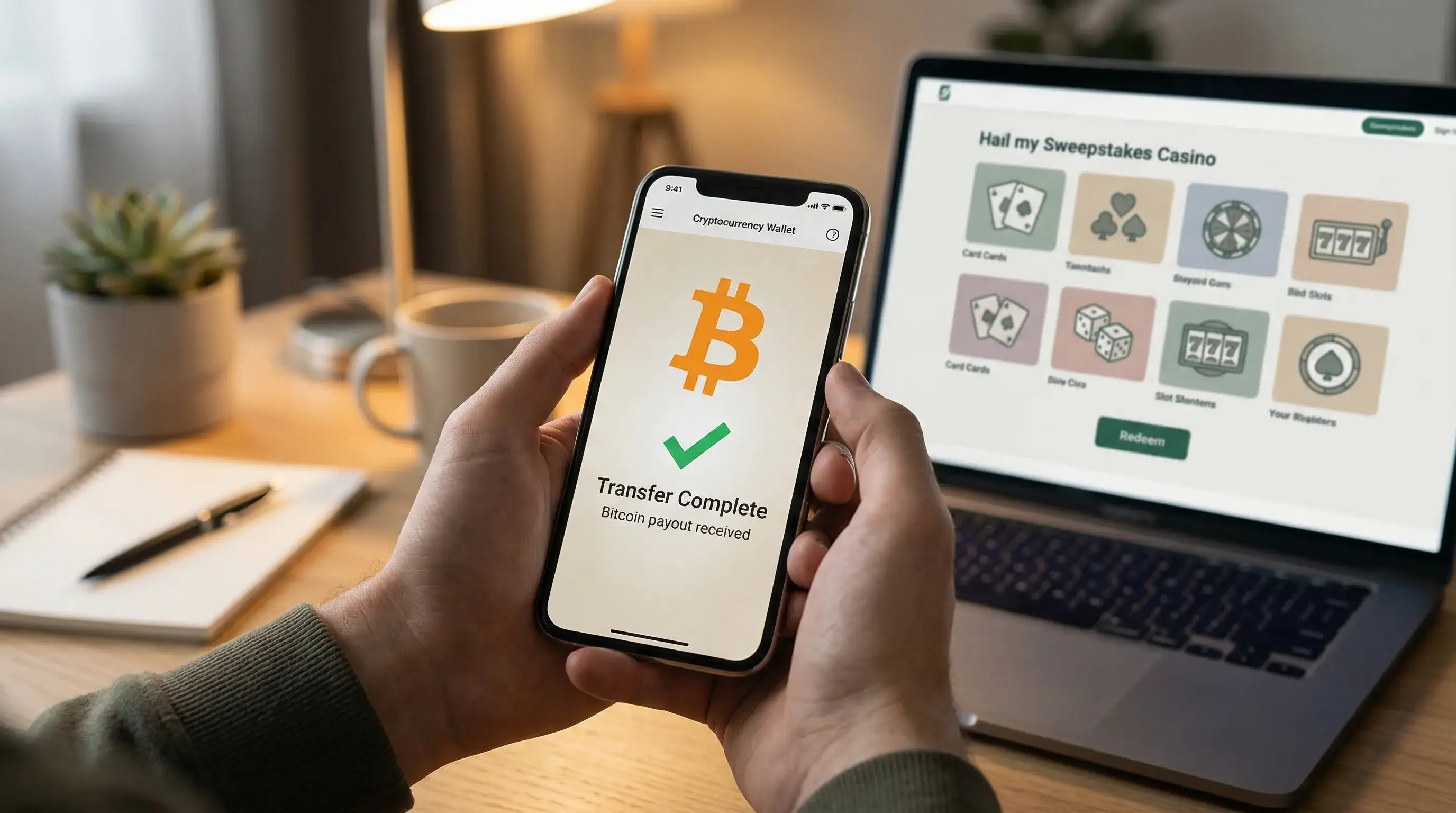
Faster payouts, modern methods. Cryptocurrency redemption has emerged as a compelling alternative to traditional withdrawal options at sweepstakes casinos, offering speed advantages that bank transfers simply cannot match. While ACH withdrawals typically require three to five business days and e-wallets need 24 to 48 hours, crypto payouts often complete within hours—sometimes minutes—once approved by the platform.
The appeal extends beyond speed. Crypto withdrawals work independently of banking hours and holidays, process without the involvement of traditional financial institutions, and provide a degree of transaction privacy that some players prefer. But cryptocurrency isn’t without complications. Wallet management, network fees, price volatility, and tax reporting requirements add layers of complexity absent from conventional cash-out methods. Understanding these tradeoffs helps you decide whether crypto redemption suits your situation and how to execute it properly when it does.
Crypto Payouts at Sweepstakes Casinos — More on this topic at free sweepstakes casino.
Supported Cryptocurrencies
Bitcoin dominates the sweepstakes casino crypto landscape. Nearly every platform offering cryptocurrency withdrawals supports BTC, making it the default choice for players entering the crypto redemption space. Bitcoin’s widespread adoption means extensive documentation, robust wallet options, and straightforward conversion paths to fiat currency when needed. If you’re uncertain which cryptocurrency to use, Bitcoin provides the safest starting point.
Ethereum ranks second in availability, supported by most platforms that accept crypto withdrawals. ETH transactions typically confirm faster than Bitcoin and often carry lower network fees during normal conditions, though Ethereum’s fee structure can spike unpredictably during periods of high network activity. Players comfortable with Ethereum’s ecosystem may prefer it for routine withdrawals, reserving Bitcoin for larger redemptions where security considerations outweigh speed.
Litecoin appears at many sweepstakes casinos as a third option. LTC processes faster than Bitcoin with consistently lower fees, positioning it as a practical middle ground for players prioritizing transaction efficiency. The coin’s lower value per unit compared to BTC or ETH also makes it psychologically easier for some users to manage—sending 50 LTC feels different from sending 0.05 BTC, even when the dollar values match.
Beyond the major three, some platforms support additional altcoins: Bitcoin Cash, Dogecoin, USDT (Tether), USDC, and occasionally others. Stablecoin options like USDT and USDC eliminate price volatility between redemption and conversion, delivering exactly the dollar value you withdrew regardless of how long you hold before converting. Availability varies significantly by platform, so check your specific casino’s redemption page for current cryptocurrency options.
Setting Up Crypto Withdrawals
Before requesting your first crypto withdrawal, you need a wallet address capable of receiving the cryptocurrency you’ve chosen. This isn’t a sweepstakes casino account feature—it’s external infrastructure you must establish independently. Wallet options fall into several categories: exchange wallets hosted by platforms like Coinbase or Kraken, software wallets installed on your computer or phone, and hardware wallets stored on dedicated physical devices.
Exchange wallets offer the easiest onramp for crypto newcomers. Create an account at a major cryptocurrency exchange, complete their identity verification process, and you’ll receive wallet addresses for supported coins. These addresses work for receiving sweepstakes redemptions, and the exchange provides built-in options for converting crypto to dollars and withdrawing to your bank account. The tradeoff is custodial risk—your coins sit on the exchange’s servers rather than under your direct control.
Software wallets provide more control at the cost of more responsibility. Applications like Exodus, Trust Wallet, or Electrum generate wallet addresses that you control through private keys stored on your device. Lose access to those keys and your funds become unrecoverable—no customer support exists to reset your password. For players planning significant crypto redemptions, the self-custody model offers important security advantages, but it demands careful key management practices.
Once you have a wallet address, link it to your sweepstakes casino account. Navigate to the redemption or withdrawal section, select cryptocurrency as your payout method, choose your preferred coin, and enter your wallet address exactly as provided by your wallet application. Triple-check this address before confirming—cryptocurrency transactions cannot be reversed, and funds sent to incorrect addresses are permanently lost. Some platforms require you to verify new wallet addresses via email before processing withdrawals, adding a safety layer against address entry errors.
Complete KYC verification if you haven’t already. Sweepstakes casinos require identity verification before any redemption regardless of method, and crypto withdrawals are no exception. Your verified name, address, and documentation must match your account details before crypto payouts will process.
See also Sweepstakes Casino RTP.
Speed Comparison: Crypto vs Traditional Methods
Cryptocurrency’s primary advantage is speed. Once a sweepstakes casino approves your withdrawal request—completing their internal review, fraud checks, and any pending playthrough verification—the external transfer phase begins. Bank transfers via ACH typically require three to five business days from this point. E-wallets like Skrill or PayPal usually complete within 24 to 48 hours. Cryptocurrency? Often under 12 hours, frequently under one hour, and sometimes within minutes.
The speed difference stems from infrastructure. ACH transfers route through the Federal Reserve’s batch processing system, which operates on banking business days and settles transactions in scheduled windows. E-wallets process faster but still depend on traditional banking rails for their backend operations. Cryptocurrency networks operate 24/7, processing transactions whenever miners or validators confirm them—no weekends, no holidays, no banking hours.
Bitcoin confirmation times average around 10 minutes per block, with most recipients considering transactions final after three to six confirmations. Ethereum confirms faster, typically within a few minutes. Litecoin splits the difference with approximately 2.5-minute block times. These timeframes represent network processing only; add the casino’s internal approval period for total elapsed time from request to receipt.
Real-world crypto withdrawal speeds vary based on platform efficiency. Some casinos batch crypto payouts at scheduled intervals rather than processing immediately upon approval. Others maintain hot wallets enabling near-instant disbursement. If speed is your priority, research your specific platform’s crypto processing practices before assuming instant delivery. Faster payouts, modern methods—but actual timelines depend on implementation details beyond blockchain speed alone.
Fees and Network Considerations
Cryptocurrency withdrawals involve fees that traditional methods avoid. Network fees—paid to miners or validators processing your transaction—vary based on blockchain congestion and transaction complexity. Bitcoin fees fluctuate significantly; during calm periods, a transaction might cost a few dollars, while network congestion can push fees to $20 or more. Ethereum fees exhibit even greater volatility, occasionally spiking during high-demand periods.
Some sweepstakes casinos absorb network fees for withdrawals, sending you the full redemption amount while covering transaction costs themselves. Others pass fees through to players, deducting them from your withdrawal amount. A few impose additional processing fees on top of network costs. Review your platform’s fee structure before selecting crypto withdrawal—the speed advantage may not justify fees that exceed what you’d pay for slower alternatives.
Timing your withdrawals can minimize costs. Bitcoin and Ethereum fees typically drop during low-activity periods, often weekends or overnight hours in US time zones. If your withdrawal isn’t urgent, monitoring fee levels through blockchain explorers and withdrawing during cheaper windows can meaningfully reduce costs. For Litecoin and stablecoins, fees remain more consistent and generally lower, making them practical choices for fee-conscious players.
Tax Implications
Receiving cryptocurrency doesn’t exempt you from tax obligations on sweepstakes winnings. The IRS treats sweepstakes prizes as taxable income regardless of how you receive them. Redemptions of $600 or more typically trigger reporting requirements, with platforms issuing Form 1099-MISC documenting the prize value. For larger wins exceeding $5,000, federal withholding of 24% may apply at the source before you receive any payout.
The taxable amount is determined at the moment of redemption based on the fair market value of cryptocurrency received. If you redeem 0.1 BTC when Bitcoin trades at $50,000, you’ve received $5,000 in taxable prize value—regardless of what Bitcoin’s price does afterward. This creates documentation requirements: record the exact redemption amount, date, time, and prevailing exchange rate for your tax records.
Subsequent cryptocurrency transactions introduce additional complexity. If Bitcoin’s price increases after you receive it and you later sell for dollars, the appreciation constitutes a capital gain separate from your original sweepstakes income. Conversely, if prices fall before you convert, you may realize a capital loss. These gains and losses follow standard crypto tax rules, requiring tracking of your cost basis (the fair market value at redemption) against your eventual sale price.
Players treating sweepstakes winnings as regular income and immediately converting crypto to dollars face simpler accounting. Your taxable prize equals the dollar amount received through conversion, and no subsequent capital gains tracking is necessary. Those holding cryptocurrency long-term must maintain detailed records of redemption values, holding periods, and sale prices. Consider consulting a tax professional familiar with both gambling winnings and cryptocurrency if your situation involves significant amounts or complex holding patterns.
Created by the "Free Sweepstakes Casino" editorial team.