
California Sweepstakes Casino Ban 2026: What AB 831 Means for Players
 Available in US
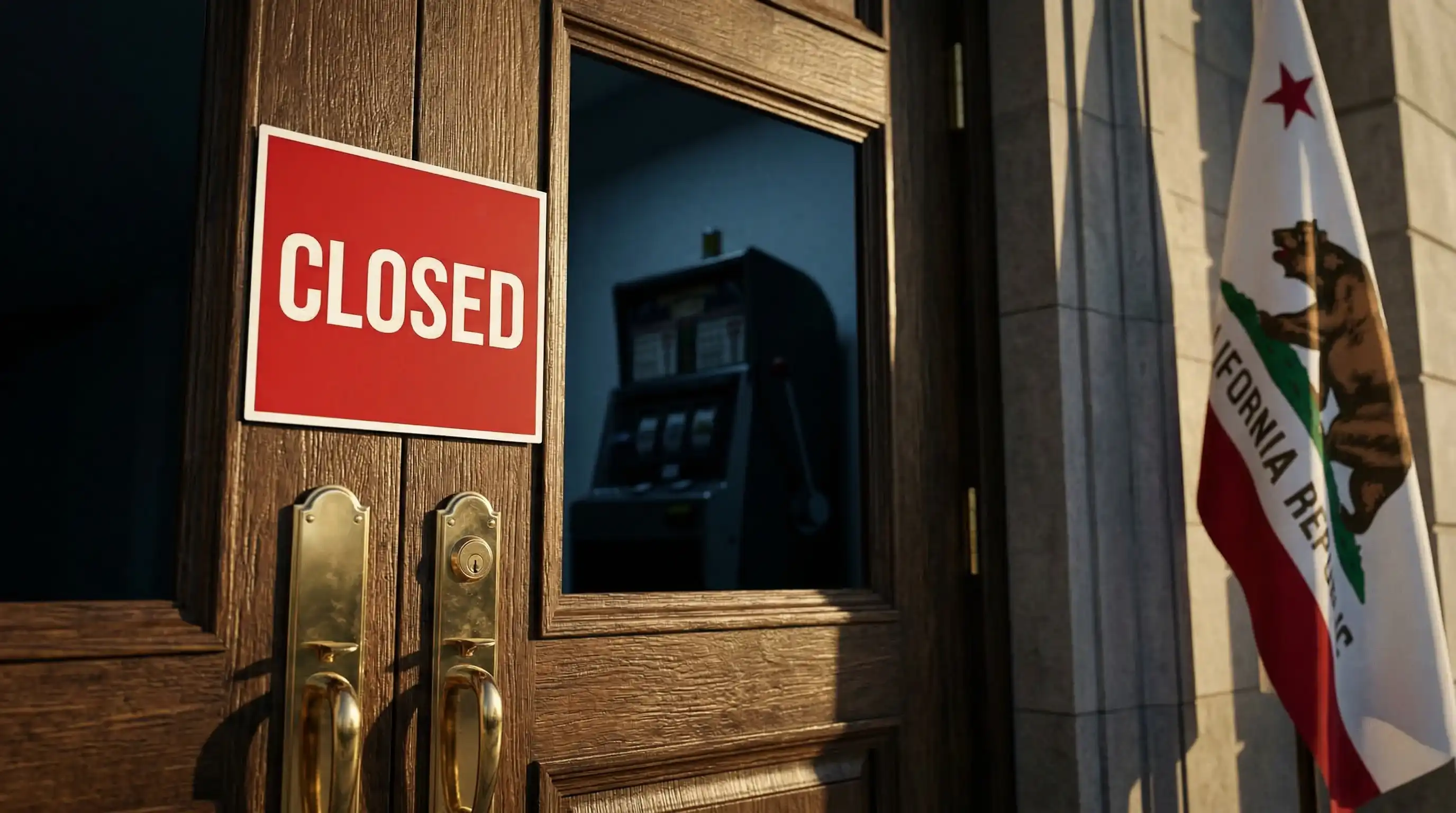
On January 1, 2026, California became the largest state in America to shut out sweepstakes casinos entirely. Assembly Bill 831, signed by Governor Gavin Newsom in October 2025, reclassified these platforms as illegal gambling operations. The sweepstakes model that had operated in a gray zone for years was suddenly black and white: play from California, face the consequences.
The numbers tell the story of what the industry lost. California represented $2.42 billion in sweepstakes casino sales during 2025—roughly 17.3% of the entire U.S. market, according to data compiled by Eilers & Krejcik Gaming for the Social Gaming Leadership Alliance. With 39 million residents, California wasn’t just a state on the map for sweepstakes operators. It was the map.
The ban didn’t materialize overnight. It emerged from a collision of tribal gaming interests, consumer protection concerns, and a legislative environment that had grown increasingly skeptical of the sweepstakes loophole. What makes California’s move particularly significant is the bipartisan consensus behind it: AB 831 passed without a single dissenting vote in either chamber. When Sacramento agrees on anything these days, you know the political winds have shifted decisively.
Understanding the California ban matters beyond state borders. The same arguments deployed against sweepstakes casinos in Sacramento are circulating in state capitols across the country. New York followed California’s lead within months. Other states are watching to see whether prohibition or regulation offers the more viable path. For the sweepstakes industry, California wasn’t just a market loss—it was a signal that the legal gray zone they’d operated in was shrinking fast.
This guide breaks down exactly what happened, why it happened, and what options remain for California residents who enjoyed sweepstakes casino games. The situation is straightforward but the details matter—especially if you had an active account when the clock struck midnight on New Year’s Eve.
California Sweepstakes Casino Ban 2026 — More on this topic at free sweepstakes casino.
AB 831: The Law That Changed Everything
Timeline: From Introduction to Law
AB 831 moved through the California legislature with unusual speed and even more unusual unity. Assemblymember Avelino Valencia introduced the bill in February 2025, framing it as a consumer protection measure necessary to close a loophole that allowed unregulated gambling to flourish under the guise of promotional sweepstakes.
The bill advanced through committee hearings during the spring and summer of 2025, gathering momentum as tribal gaming interests aligned with consumer advocacy groups. By September, AB 831 had reached the floor votes. The results weren’t even close. The California State Senate passed the measure 36-0. The Assembly followed with a 63-0 vote. In a legislature known for partisan gridlock, sweepstakes casinos had accomplished the rare feat of unifying both parties—against them.
Governor Newsom signed AB 831 into law on October 11, 2025. The effective date was set for January 1, 2026, giving operators roughly eleven weeks to wind down California operations and giving players roughly eleven weeks to cash out whatever Sweeps Coins remained in their accounts.
What the Law Actually Prohibits
AB 831 targets the sweepstakes casino model at its core. The law amends California’s Penal Code to specifically address online platforms that use a dual-currency system—Gold Coins for play, Sweeps Coins redeemable for cash—to simulate gambling without holding a gambling license.
The legislation defines “simulated gambling” broadly enough to capture existing sweepstakes casino operations while theoretically leaving room for purely social casino games that offer no path to real-money prizes. The key distinction: if players can redeem virtual currency for cash or cash equivalents, the platform falls under AB 831’s prohibition.
The law applies to operators, not players. California residents won’t face criminal prosecution for having previously used sweepstakes casinos. The enforcement mechanism targets the companies themselves—specifically, anyone who “owns, operates, or manages” a simulated gambling platform accessible to California residents, or who “knowingly causes” such a platform to be accessible from within the state.
Operators are also prohibited from accepting payments from California residents for participation in simulated gambling activities. This provision closes the door on any argument that players could voluntarily access out-of-state platforms. If you’re in California and you’re paying to play, someone is breaking the law.
Penalties and Enforcement
AB 831 carries real teeth. Violations constitute a misdemeanor under California law, punishable by fines up to $25,000 and imprisonment in county jail for up to one year, according to the official bill analysis. For corporations, the fine threshold applies per violation—meaning an operator serving thousands of California players faces theoretical exposure in the millions.
The California Attorney General’s office holds primary enforcement authority, with the ability to seek injunctions, civil penalties, and criminal prosecution. Local district attorneys can also bring charges, adding another layer of enforcement potential. The law authorizes courts to order the disgorgement of profits derived from illegal operations—money that would flow back to state coffers rather than offshore corporate accounts.
Perhaps more practically effective than the penalty structure is the law’s impact on payment processing. Major financial institutions and payment processors have added California sweepstakes casino transactions to their prohibited activity lists. When you can’t move money, you can’t run a gambling operation. The operators who had built empires on the sweepstakes model found themselves frozen out of America’s largest state overnight.
See also Sweepstakes Casino Taxes.
Why California Banned Sweepstakes Casinos
Tribal Gaming Interests
Follow the money, and you’ll find California’s tribal gaming industry at the center of AB 831’s origin story. The state’s Native American casinos generate billions annually under compacts negotiated with the state government—compacts that grant tribes exclusive rights to operate certain types of gambling in exchange for revenue-sharing arrangements that fund state programs.
Sweepstakes casinos threatened that exclusivity. They offered slot-style games and table games to California residents without paying into the compact system, without submitting to regulatory oversight, and without geographic limitations. A player who might have driven to a tribal casino could instead pull out their phone and access essentially the same entertainment from their couch. The tribes saw their market share eroding to unregulated competition that contributed nothing to state coffers or tribal economies.
Tribal gaming associations lobbied aggressively for AB 831. Their argument was straightforward: if online gambling was going to exist in California, it should operate under the same regulatory framework and revenue-sharing obligations as brick-and-mortar tribal operations. The sweepstakes model, in this view, represented a loophole that allowed operators to extract value from California’s gambling market without any of the responsibilities that tribal casinos accepted.
The financial stakes were substantial. California’s tribal casinos collectively generate revenues in the billions, supporting tribal communities and funding state programs through negotiated revenue-sharing agreements. Every dollar spent at an online sweepstakes casino was a dollar not spent at a tribal property. The tribes had negotiated their market position through years of legal and political work; watching that position erode to unregulated digital competition was unacceptable.
Consumer Protection Concerns
The consumer protection argument against sweepstakes casinos focused on what they lacked: meaningful oversight. Licensed gambling operations in California submit to regular audits, maintain responsible gambling programs, verify player ages through rigorous protocols, and answer to regulatory bodies with real enforcement power. Sweepstakes casinos operated outside this framework.
Critics pointed to the absence of mandatory responsible gambling tools, limited age verification procedures, and no requirement to disclose actual odds or return-to-player percentages. When something went wrong—disputed transactions, withheld payouts, account closures—players had no regulatory body to appeal to and no legal framework for resolution.
Problem gambling advocates added their voices to the consumer protection chorus. Without mandatory deposit limits, self-exclusion programs, or cooling-off periods, sweepstakes casinos offered fewer safeguards than regulated gambling operations. The 24/7 accessibility from any smartphone amplified concerns about compulsive play patterns—concerns that resonated in a state already grappling with gambling addiction through its tribal and cardroom sectors.
“These companies were exploiting a technicality. AB 831 reaffirms that gambling in California must be licensed, transparent, and accountable,” stated Assemblymember Avelino Valencia when the bill passed. The sentiment captured the legislature’s view that the sweepstakes distinction was a legal fiction designed to evade gambling regulations rather than a genuinely different form of entertainment.
Political Dynamics
The unanimous votes tell only part of the political story. AB 831 succeeded because it aligned interests that rarely overlap in California politics. Tribal nations brought their lobbying infrastructure and campaign contributions. Consumer advocacy groups provided moral authority and grassroots support. Law enforcement agencies offered testimony about the challenges of regulating offshore operators. Even some segments of the traditional gambling industry saw sweepstakes casinos as unfair competition.
Notably absent from the opposition was any significant political constituency. Sweepstakes casino operators were mostly based outside California—many outside the United States entirely. They lacked local employment bases that might have generated worker advocacy. They lacked deep relationships with California legislators. When they mounted a defense, it came too late and with too little political capital to matter.
The industry’s main advocacy organization, the Social Gaming Leadership Alliance, attempted to reframe the debate around consumer choice and the economic impact of prohibition. But in a state where regulated gambling had established political legitimacy over decades, the unregulated alternative couldn’t compete for legislative sympathy.
Impact on the Sweepstakes Industry
Revenue Loss and Industry Projections
California’s exit from the sweepstakes casino market carved out a substantial chunk of industry revenue. The $2.42 billion in California sales represented 17.3% of total U.S. sweepstakes volume—the single largest state market by a significant margin. No other state came close to California’s combination of population size, internet connectivity, and demographic appeal for online gaming.
The timing amplified the damage. Eilers & Krejcik Gaming, which tracks the sweepstakes industry, had projected continued growth through 2025 and beyond. Those projections assumed California would remain accessible. When AB 831 became law, the firm revised its 2025 net revenue forecast downward from $4.7 billion to approximately $4 billion—a reduction driven almost entirely by California’s closure.
For individual operators, the impact varied based on California exposure. Platforms with heavy California player bases faced immediate revenue drops of 15-20%. Some smaller operators, over-indexed in the California market, reportedly saw even steeper declines. The industry’s overall growth trajectory, which had maintained a compound annual growth rate between 60-70% from 2020 through 2024, finally encountered a ceiling it couldn’t break through.
How Operators Responded
Major sweepstakes casino platforms began implementing California blocks in late December 2025, ahead of the January 1 deadline. Players attempting to access sites from California IP addresses encountered state restriction messages. Geolocation technology—the same systems used by regulated sportsbooks—suddenly served to exclude rather than include.
Account handling became an immediate operational challenge. Operators had to decide what to do with California players’ existing balances. Most implemented a grace period allowing players to redeem remaining Sweeps Coins before accounts were deactivated. Some converted unredeemed balances to Gold Coins—essentially converting redeemable currency to play-only credits that would become inaccessible once accounts closed.
The Social Gaming Leadership Alliance, representing major sweepstakes operators, publicly opposed the ban while complying with its requirements. Industry representatives emphasized their preference for regulation over prohibition and signaled openness to working within a licensed framework if California ever established one. Whether that represented genuine policy preference or strategic positioning for future legislative battles remains unclear.
What Happened to California Players
For the estimated millions of California residents who had used sweepstakes casinos, the transition was abrupt. Players who maintained active accounts received emails in December 2025 explaining the upcoming change and providing deadlines for redemption. Those who acted promptly could cash out their Sweeps Coin balances through normal channels.
Players who missed the window faced more complicated situations. Some operators extended individual grace periods on request. Others applied strict cutoff dates after which California balances became forfeit or converted to non-redeemable credits. The inconsistency across platforms created confusion and, inevitably, frustration.
No pathway exists for California residents to continue playing legally at sweepstakes casinos. The platforms are inaccessible. The payment methods are blocked. The legal prohibition applies regardless of where the platform is technically based. For players who had incorporated sweepstakes casinos into their entertainment routines, January 2026 marked a hard stop.
Alternatives for California Players
Tribal Casinos
California hosts one of the largest tribal casino industries in the United States. More than 60 tribal gaming facilities operate across the state, ranging from modest gaming halls to full-scale casino resorts rivaling anything in Las Vegas. For players seeking slot machines, table games, and the broader casino experience, these brick-and-mortar establishments represent the primary legal alternative.
The geographic distribution favors Southern California, where major properties cluster in the San Diego, Riverside, and San Bernardino areas. Northern California offers fewer options but still maintains several significant tribal casinos in the Sacramento region and near the Bay Area. Most major tribal casinos offer loyalty programs, promotional incentives, and the full range of gaming entertainment—just without the convenience of playing from home.
It’s worth noting that California’s tribal casinos do not currently offer online gambling. The same compact framework that protects tribal gaming exclusivity also limits digital expansion. Some tribes have explored online poker legislation, but as of 2026, no legal pathway exists for online casino gaming through tribal operators. You can visit their properties; you cannot access their games remotely.
Licensed Cardrooms
California’s cardrooms offer another legal gambling option, though with more limited game selection. The state licenses approximately 80 cardrooms that operate various poker formats and California-style banked card games. These establishments differ from tribal casinos in their regulatory framework and game offerings—you won’t find slot machines or traditional table games like blackjack or roulette.
For poker players specifically, cardrooms provide live games ranging from low-stakes recreational tables to high-limit professional action. Major cardrooms in Los Angeles, the Bay Area, and other population centers run regular tournaments alongside cash games. The experience differs fundamentally from sweepstakes casinos, but for players whose primary interest was poker, the cardroom scene offers legitimate alternatives.
What About Neighboring States?
Some California residents have wondered whether traveling to Nevada, Arizona, or other neighboring states might provide access to sweepstakes casinos. This approach misunderstands both the law and the technology.
California’s AB 831 prohibits operators from accepting California residents—not just California connections. While enforcement against individual players isn’t the law’s focus, attempting to circumvent geolocation restrictions creates its own problems. Most platforms require identity verification that includes proof of residence. Using VPNs or location spoofing to access blocked platforms violates terms of service at minimum and potentially constitutes fraud.
Nevada, meanwhile, has its own sweepstakes casino restrictions. The state that legalized traditional gambling never embraced the sweepstakes model—licensed casinos had no interest in welcoming unregulated competition. Arizona and other neighboring states vary in their treatment of sweepstakes casinos, but none offer a clean workaround for California residents seeking to continue their previous playing habits.
The reality: if you’re a California resident who enjoyed sweepstakes casinos, those platforms are no longer available to you through any legal channel. The end of sweepstakes in California means exactly that.
What’s Next: Legal Challenges and Future Prospects
Legal Challenges and Industry Response
The sweepstakes industry hasn’t accepted California’s ban quietly. Legal challenges have been explored, though none have gained significant traction as of early 2026. The core difficulty for any challenge is the overwhelming legislative consensus behind AB 831—courts typically defer to clearly expressed legislative intent, and a unanimous bipartisan vote leaves little room for claims that the law exceeds state authority.
The Social Gaming Leadership Alliance has focused its response on public messaging rather than litigation. “Voters, players who love online social games, California tribes, and online social games operators all made their position clear: they didn’t want a ban on this popular, safe form of entertainment,” stated Jeff Duncan, the organization’s executive director. The statement reflects an industry position that the ban was politically driven rather than policy-driven, and that public opinion might eventually force reconsideration.
Some operators have explored constitutional arguments based on interstate commerce and First Amendment grounds, arguing that promotional sweepstakes constitute protected speech or that California cannot regulate platforms based entirely outside its borders. Legal scholars generally view these arguments as unlikely to succeed—states have broad authority to regulate gambling-adjacent activities, and the in-state effects of sweepstakes casino access provide sufficient jurisdictional hooks.
Could California Regulate Instead of Ban?
The theoretical alternative to prohibition was always regulation: bring sweepstakes casinos under state oversight, require licensing, impose responsible gambling requirements, and collect tax revenue. This approach worked for sports betting in other states and for traditional casino gambling through tribal compacts.
The problem is political, not conceptual. Any regulatory framework for online sweepstakes casinos would immediately conflict with existing tribal gaming compacts. Those compacts, negotiated over decades, grant tribes exclusive or near-exclusive rights to various forms of gambling in exchange for revenue sharing. Introducing a new regulated category of online gambling outside the compact system would face fierce tribal opposition—the same opposition that made AB 831 possible.
A regulated sweepstakes market in California would require either tribal buy-in (unlikely given their current position) or a willingness by state legislators to challenge powerful tribal interests (even less likely given the political landscape). The easier path was prohibition, and that’s the path California chose.
Realistic Expectations
For California residents hoping the sweepstakes ban might be temporary, the honest assessment is discouraging. No significant legislative movement toward repeal or reform has emerged in the months since AB 831 took effect. The coalition that supported the ban remains intact and politically potent.
The broader trend in sweepstakes casino regulation nationally points toward more restrictions rather than fewer. New York enacted its own ban in December 2025. New Jersey implemented aggressive regulation. Tennessee and Louisiana sent cease-and-desist letters to dozens of operators. California’s action fits a pattern of states reasserting control over gambling markets that sweepstakes operators had accessed without explicit permission.
If change comes to California’s sweepstakes policy, it will likely take the form of regulated online gambling legislation that establishes a licensed framework from the ground up—not a reversal of AB 831. And that legislation, if it ever passes, would look nothing like the sweepstakes model. The companies that built businesses on the dual-currency loophole may find themselves locked out of regulated markets that their existence helped create. Such is the nature of operating in legal gray zones: eventually, the gray becomes black or white, and operators rarely get to choose which.
Created by the "Free Sweepstakes Casino" editorial team.