
Free Sweeps Coins by Mail: AMOE Request Guide & Templates
 Available in US
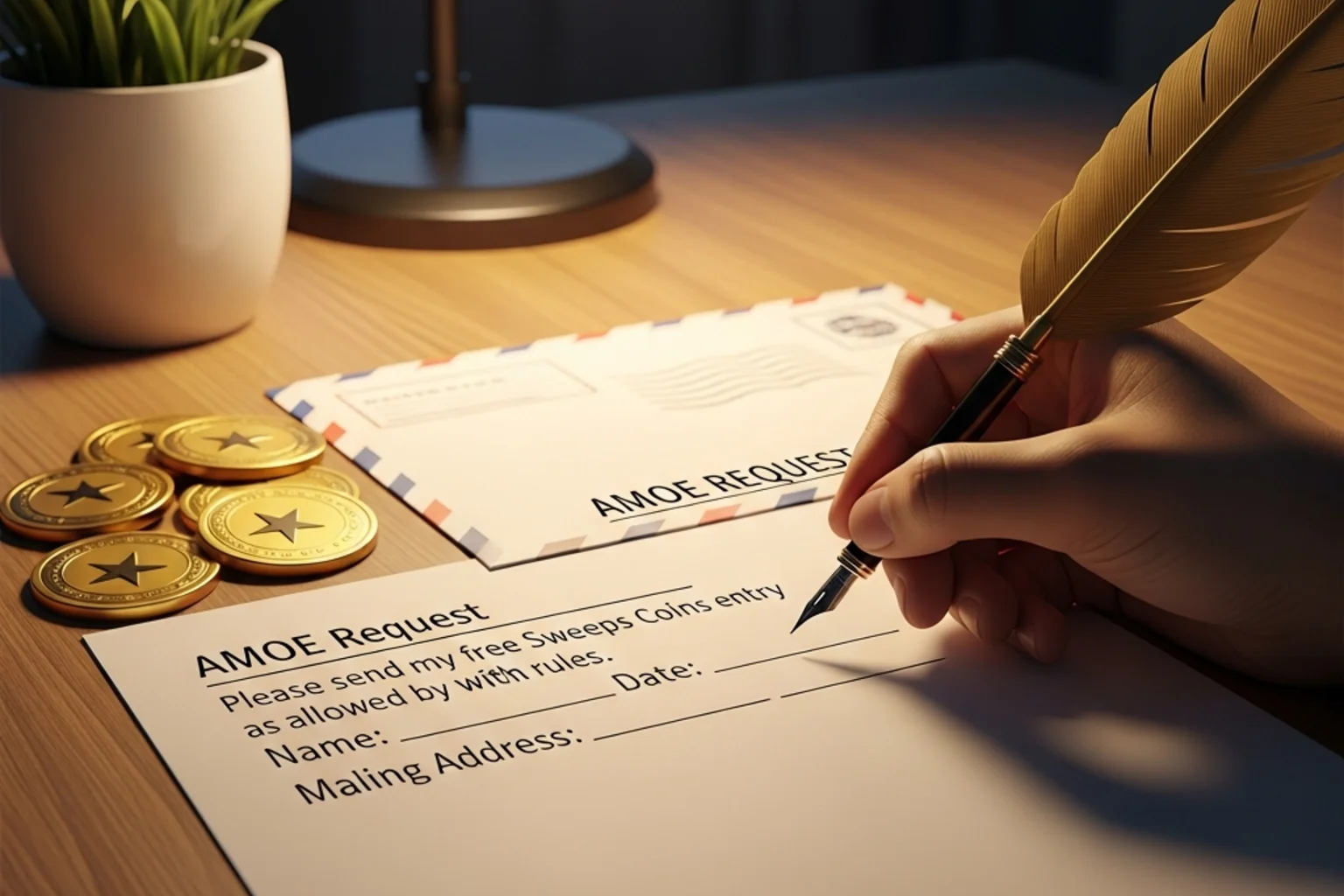
Free coins, postage only. Every legitimate sweepstakes casino operating in the 35+ states where the model is permitted must offer an Alternative Method of Entry—AMOE—that lets players obtain Sweeps Coins without making any purchase. The most common AMOE involves mailing a handwritten request to the platform, which then credits your account with free Sweeps Coins. This requirement isn’t optional generosity; it’s the legal foundation that distinguishes sweepstakes promotions from gambling.
Understanding how AMOE requests work—and actually using them—can substantially reduce your cost of play. Most players never bother with mail-in requests, either unaware they exist or assuming the process is too cumbersome. In reality, a few minutes of writing and a stamp can yield the same Sweeps Coins that would otherwise require purchasing Gold Coin packages. The math favors those willing to invest minimal effort. This guide walks through the legal foundation, practical process, and realistic expectations for AMOE participation.
What Is AMOE
AMOE stands for Alternative Method of Entry, a legal requirement for sweepstakes promotions under Federal Trade Commission guidelines and state consumer protection laws. The principle is straightforward: if a promotion awards prizes, participants must have a free way to enter that doesn’t require purchase. This “no purchase necessary” element transforms what would otherwise be an illegal lottery into a legal promotional sweepstakes.
For sweepstakes casinos, AMOE typically manifests as mail-in requests for Sweeps Coins. By sending a handwritten letter or postcard to a specified address, players can receive free Sweeps Coins credited to their accounts. The platform absorbs the cost of providing these coins because doing so maintains their legal status as a sweepstakes promotion rather than a gambling operation.
The requirement explains why sweepstakes casinos can operate in states that prohibit traditional online gambling. Since players can obtain the prize-eligible currency without spending money, the platforms argue they’re running promotional sweepstakes rather than gambling services. Courts and regulators have generally—though not universally—accepted this distinction, enabling the industry’s expansion across most of the country.
AMOE options beyond mail-in requests exist at some platforms. Social media giveaways, daily login bonuses, and promotional codes all serve as alternative entry methods. However, mail-in requests typically offer the most generous and reliable Sweeps Coin allocations, making them worth the effort for serious players seeking to maximize free play opportunities.
Free Sweeps Coins by Mail — More on this topic at free sweepstakes casino.
Legal Foundation
The legal requirement for free entry methods traces to lottery law. Lotteries—defined as promotions combining prize, chance, and consideration (payment)—are heavily regulated and generally prohibited except for state-run operations. Remove any one element, and the promotion escapes lottery classification. Sweepstakes casinos remove consideration by offering free entry through AMOE, maintaining their legal distinction from gambling operations.
FTC regulations governing sweepstakes require clear disclosure of free entry options. Platforms must prominently display AMOE information, not bury it in fine print or make the process unreasonably difficult. The free entry method must provide equivalent chances of winning as paid entry—you can’t offer ten Sweeps Coins for a $10 purchase but only one for a mail-in request.
This equivalence requirement matters for players. The Sweeps Coins obtained through AMOE function identically to those received with Gold Coin purchases. They carry the same redemption value, work in the same games, and face the same wagering requirements. The only difference is acquisition method—mail versus purchase.
State-level variations affect AMOE implementation. Some states require specific disclosures or impose additional requirements on sweepstakes promotions. Platforms operating nationally must navigate this patchwork, which explains why AMOE terms and processes sometimes differ between platforms even when the underlying concept remains consistent. Research from the American Gaming Association indicates that approximately 90% of players perceive sweepstakes casinos as gambling despite the legal distinction—a perception gap that doesn’t affect AMOE validity but does explain why the industry faces ongoing regulatory scrutiny despite technical compliance with sweepstakes law.
How to Request
Each sweepstakes casino publishes specific AMOE instructions, typically found in their terms and conditions, FAQ sections, or dedicated promotional rules pages. These instructions specify the mailing address, required information, and any formatting requirements. Following these instructions precisely matters—requests that deviate from stated requirements may be rejected or delayed.
Standard AMOE requests require handwritten elements. Most platforms explicitly prohibit typed or printed requests, requiring that you physically write the necessary information by hand. This requirement exists to prevent mass automated submissions and ensures that the effort involved roughly corresponds to reasonable participation limits.
Required information typically includes your full legal name matching your account registration, your registered email address, your physical mailing address, a statement requesting Sweeps Coins through the AMOE program, and the date of your request. Some platforms require additional elements like your username or account number. Include everything specified to avoid rejection.
Mailing specifications vary. Some platforms accept postcards; others require letters in envelopes. Return address requirements differ. Postage requirements are always standard first-class mail—no platform requires express shipping or special handling. Check your specific platform’s requirements before preparing your request to ensure compliance.
See also KYC Verification at Sweepstakes Casinos.
Template Examples
A basic AMOE request letter follows this structure. On a standard sheet of paper or index card, handwrite the following elements: your full name as registered on your account, your email address associated with the account, your complete mailing address including city, state, and ZIP code, a clear statement such as “I am requesting free Sweeps Coins through the AMOE program,” and the current date. Sign the letter. Address the envelope to the platform’s specified AMOE address and mail with appropriate postage.
For postcard requests where permitted, condense the same information onto a standard postcard. Write your request statement and personal information on the message side. Address the platform on the recipient side. The postcard format saves envelope costs but works only at platforms explicitly accepting this format—verify before sending.
Keep copies of your requests. Photograph or photocopy each letter before mailing. Note the date sent and the platform addressed. This documentation helps if requests go missing or if you need to verify your submission history. Organized record-keeping becomes particularly valuable when managing AMOE requests across multiple platforms.
Limits and Expectations
Platforms impose limits on AMOE requests to prevent abuse. Common restrictions include one request per day, per envelope, or per stamp. Some platforms limit total monthly requests or impose waiting periods between submissions. Exceeding stated limits typically results in ignored requests rather than account penalties, but respecting the rules maintains good standing.
Processing times vary significantly. Some platforms credit Sweeps Coins within days of receiving your request; others take weeks. Mail delivery adds transit time in both directions. Expect at least one to two weeks from mailing to credit, and don’t panic if processing takes longer. Batch processing, verification procedures, and mail handling all introduce delays.
Sweeps Coin quantities from AMOE typically match or approximate the bonus coins included with small Gold Coin purchases. If a platform offers 2 Sweeps Coins with a $5 Gold Coin package, expect roughly similar amounts from mail-in requests. The value proposition becomes clear: a stamp costs less than a dollar, potentially yielding several dollars worth of play value.
Track your submissions and results. Note which platforms honor requests reliably and which seem to lose them. Adjust your AMOE strategy based on actual experience rather than theoretical entitlements. Some players maintain spreadsheets tracking request dates, receipt confirmations, and credited amounts across multiple platforms. This systematic approach maximizes returns while identifying any processing issues early. Free coins, postage only—but only if the platform actually processes your requests consistently.
Created by the "Free Sweepstakes Casino" editorial team.