New York Sweepstakes Casino Ban: S.5935A Law & Player Options
 Available in US
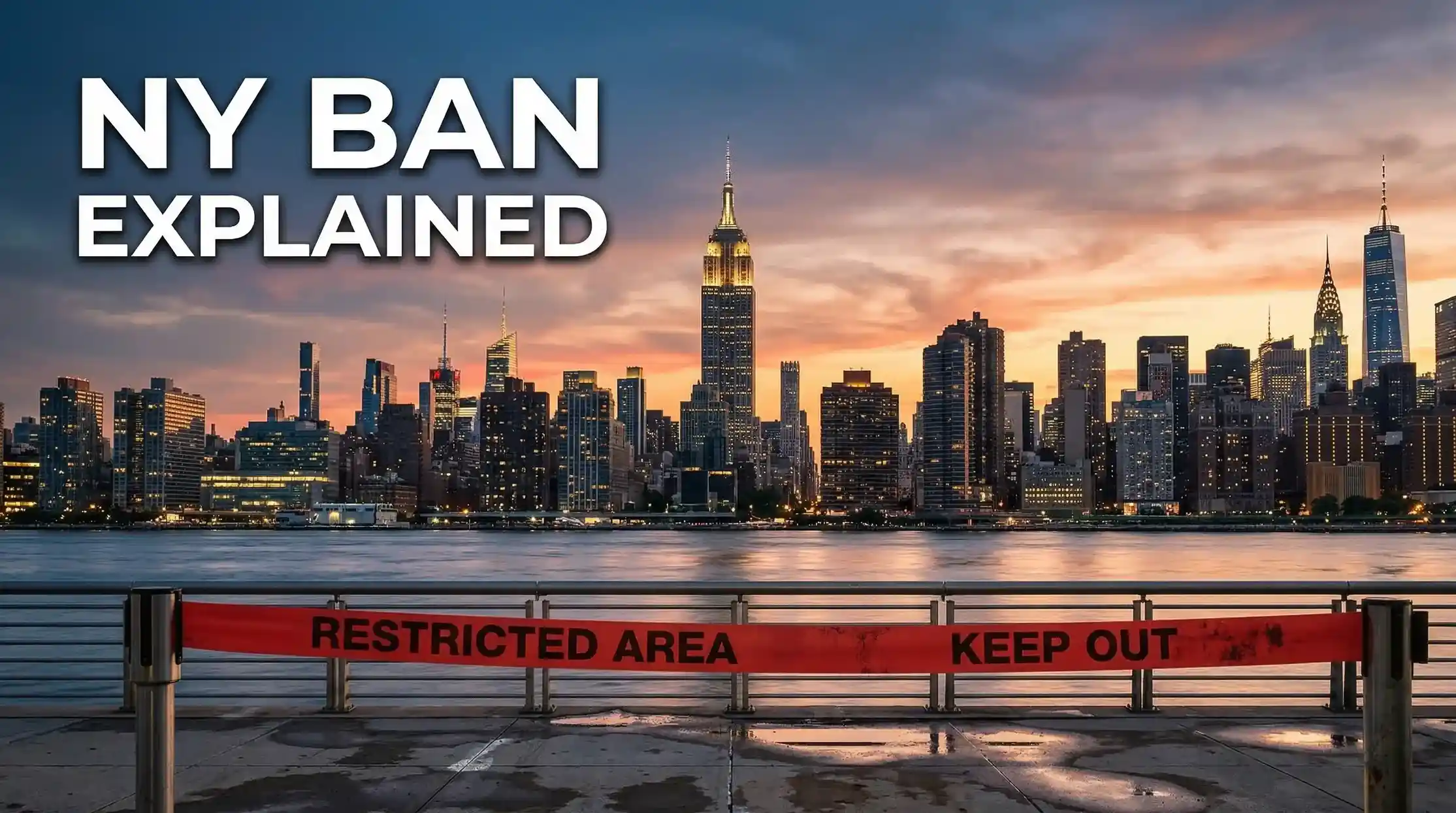
The Empire State’s crackdown arrived swiftly and decisively. On December 8, 2025, Governor Kathy Hochul signed S.5935A into law, effectively banning sweepstakes casinos from operating in New York. The legislation, championed by Senator Joseph Addabbo Jr. and supported by Attorney General Letitia James, classified these platforms as illegal gambling operations rather than legitimate promotional sweepstakes. For the estimated hundreds of thousands of New York residents who had been playing at sweepstakes casinos, the law created an immediate and uncomfortable reality: their accounts became inaccessible overnight.
New York’s action didn’t emerge from nowhere. It followed months of regulatory pressure, cease-and-desist orders, and public statements from state officials warning that sweepstakes casinos violated existing gambling laws. The ban represents one of the most significant regulatory actions against the sweepstakes casino industry, closing off a market that generated an estimated $762 million in 2024. Understanding what happened, why it happened, and what options remain matters for anyone affected by the Empire State’s crackdown.
New York Sweepstakes Casino Ban — More on this topic at free sweepstakes casino.
Understanding S.5935A
Senate Bill 5935A, signed into law as Chapter 605 of the Laws of 2025, amended New York’s penal code to explicitly address sweepstakes casinos. The legislation’s core argument rejected the industry’s legal framework entirely. Senator Addabbo articulated the position clearly: “If a game on your phone or computer looks like a casino game, acts like a casino game, and pays out real money winnings like a casino game, then it is a casino gambling game, thus currently illegal and should not operate in New York without proper regulation.”
The law targets the dual-currency model that sweepstakes casinos use to distinguish themselves from traditional gambling. Under this model, players purchase Gold Coins (play money) and receive Sweeps Coins as a promotional bonus, which can later be redeemed for cash prizes. Sweepstakes operators have long argued this structure qualifies as a legitimate promotional sweepstakes rather than gambling. New York’s legislature disagreed, finding that the practical experience—wagering virtual currency on casino-style games for potential cash prizes—constitutes gambling regardless of the technical currency mechanics.
S.5935A doesn’t merely prohibit sweepstakes casinos from accepting New York players. It creates enforcement mechanisms and penalties for operators who continue targeting Empire State residents. The law empowers the Attorney General’s office to pursue civil actions against violators and coordinates with the New York State Gaming Commission to identify and block non-compliant platforms. Internet service providers may be compelled to restrict access to banned sites under certain circumstances.
The legislation passed with broad bipartisan support, reflecting a rare consensus among New York lawmakers that sweepstakes casinos posed regulatory and consumer protection concerns requiring immediate action. Unlike California’s AB 831, which faced opposition from some consumer advocates, New York’s ban encountered minimal organized resistance during the legislative process.
Enforcement Actions
Attorney General Letitia James laid the groundwork for S.5935A through aggressive enforcement actions throughout 2025. Her office issued cease-and-desist orders to 26 sweepstakes casino operators, demanding they stop accepting New York players immediately. The letters warned that continued operation would result in civil litigation seeking injunctions, penalties, and disgorgement of profits derived from New York customers.
James framed the crackdown in stark terms: “Online sweepstakes casinos are illegal, dangerous and can seriously ruin people’s finances.” This characterization positioned sweepstakes casinos not as harmless entertainment but as predatory operations exploiting regulatory gaps. The AG’s office emphasized consumer protection concerns, citing complaints from players who experienced difficulties withdrawing funds or felt misled about the nature of the games.
The New York State Gaming Commission supported these efforts, with Chairman Brian O’Dwyer declaring that “these so-called ‘sweepstakes’ games are unscrupulous, unsecure, and unlawful.” The Commission’s involvement signaled that enforcement would extend beyond the Attorney General’s civil actions to include coordination with gaming regulators who possess specialized expertise in identifying and addressing illegal gambling operations.
Most major sweepstakes casino operators complied with the cease-and-desist orders, blocking New York IP addresses and refusing new registrations from Empire State residents. Existing New York players received notifications that their accounts would be restricted, with varying grace periods to withdraw remaining balances before access terminated completely. Some smaller or offshore operators have reportedly continued accepting New York players, though doing so now carries explicit legal risk under S.5935A.
See also Gold Coins vs Sweeps Coins.
Market Impact
New York represented one of the largest state markets for sweepstakes casinos before the ban. Industry analysts at Eilers & Krejcik Gaming estimated the state generated approximately $762 million in sweepstakes revenue during 2024, making it among the top five states nationally. Losing this market dealt a significant blow to operators who had built substantial player bases in the Empire State over several years.
The timing compounded the impact. New York’s ban arrived just weeks before California’s AB 831 took effect on January 1, 2026, meaning the sweepstakes industry lost access to two of America’s most populous states within a single month. California alone accounted for an estimated 17.3% of the national market. Combined, these bans removed roughly a quarter of the industry’s addressable US market in under 30 days.
For individual operators, the consequences varied based on their New York exposure. Platforms with heavy East Coast player concentrations faced steeper revenue declines than those with more geographically distributed user bases. Some companies reportedly laid off staff or reduced marketing budgets in response to the contracted market opportunity.
Players with existing account balances faced practical challenges during the transition. Most platforms honored withdrawal requests submitted before their compliance deadlines, though processing times stretched as support teams handled surge volumes. Players who missed withdrawal windows or had balances below minimum redemption thresholds encountered more difficulty, with some reportedly losing access to unredeemed Sweeps Coins when accounts were terminated.
Options for New York Players
Legal alternatives for New York residents seeking casino-style gaming remain limited but do exist. The state operates a robust legal sports betting market, with mobile wagering available through licensed operators since 2022. While sports betting differs fundamentally from casino gaming, it provides a regulated outlet for entertainment betting within New York’s borders.
Physical casino gaming is available at tribal casinos and licensed commercial facilities throughout the state. New York hosts multiple resort casinos in upstate regions, including properties in the Catskills and near major cities. These venues offer traditional slot machines, table games, and poker rooms under full state regulation. The experience differs from online play—requiring travel and adhering to venue hours—but represents the only currently legal path to casino gambling for New York residents.
Social casinos without cash redemption features remain legal in New York. These platforms offer casino-style games using virtual currencies that cannot be converted to real money under any circumstances. Players who enjoyed sweepstakes casinos primarily for the entertainment value rather than potential cash prizes may find social casino apps provide a similar gameplay experience, though without the redemption element.
What New York players should avoid: attempting to access sweepstakes casinos through VPNs or false registration information. Beyond violating platform terms of service and risking account termination with balance forfeiture, such circumvention may now carry legal consequences under S.5935A. The law targets operators rather than individual players, but participating in prohibited gambling activities has never been advisable from a legal risk perspective.
Future Outlook
New York’s sweepstakes casino ban appears durable for the foreseeable future. Unlike some hastily passed legislation that faces immediate legal challenges, S.5935A emerged from a deliberate process with strong backing from the Attorney General, Gaming Commission, and bipartisan legislative majorities. No significant organized effort to repeal or modify the law has materialized since its passage.
The more interesting question concerns New York’s broader approach to online casino gaming. The state has discussed legalizing iGaming—traditional online casino gambling with real-money wagering—for several years. Proponents argue that regulated online casinos would generate substantial tax revenue while providing consumer protections absent from unregulated alternatives. The sweepstakes ban may actually accelerate these discussions by eliminating the gray-market competition that complicated the regulatory landscape.
For sweepstakes casino operators, New York’s closure reinforces an industry-wide strategic challenge. The Social Gaming Leadership Alliance and individual companies have advocated for regulatory frameworks that would legitimize their operations, with some operators publicly stating they want to be regulated and pay taxes. Whether any state will create such a framework remains uncertain, but the alternative—continued state-by-state bans—threatens the industry’s long-term viability in major markets.
New York players hoping for sweepstakes casinos to return shouldn’t hold their breath. The Empire State’s crackdown reflects a clear policy determination that these platforms constitute illegal gambling, and reversing that position would require either legislative action or a fundamental shift in how courts interpret promotional sweepstakes laws. Neither outcome appears likely in the near term.
Created by the "Free Sweepstakes Casino" editorial team.